by Pradeep N
Meaning and features
The Clash of Civilizations theory, proposed by political scientist Samuel P. Huntington in a 1993 essay titled “The Clash of Civilizations?” and later expanded into a book titled “The Clash of Civilizations and the Remaking of World Order” (1996), suggests that the primary source of conflict in the post-Cold War world is cultural and civilizational differences rather than ideological or economic factors.
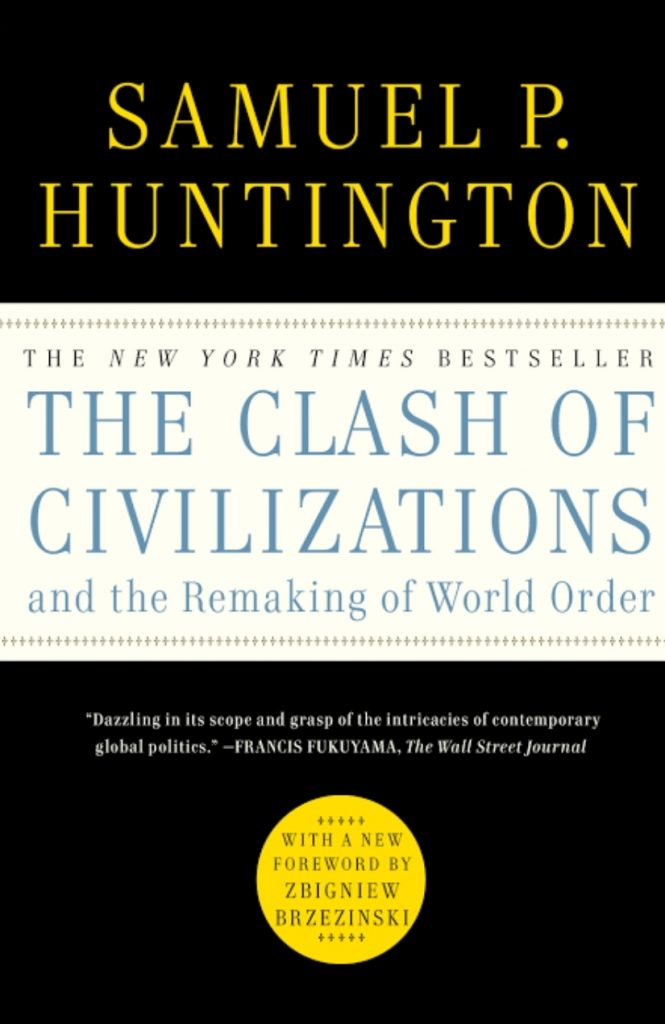
Key aspects of the Clash of Civilizations theory include:
- Civilizational Identity: Huntington argues that the world is divided into several distinct civilizations, each characterized by its own cultural, religious, and historical identity. These civilizations, such as Western, Islamic, Confucian, Hindu, and others, have deep-rooted differences in values, beliefs, and traditions.
- Conflict as Inevitable: According to Huntington, clashes between civilizations are inevitable due to the differing interests, values, and identities of these civilizations. He suggests that while conflicts may temporarily be suppressed or masked by other factors, they ultimately arise from the clash of cultural and civilizational identities.
- Post-Cold War World Order: Huntington’s theory emerged in the context of the post-Cold War world, where he argued that the ideological conflict between capitalism and communism was being replaced by cultural and civilizational conflicts. He predicted that future conflicts would occur along civilizational fault lines rather than between nation-states or ideologies.
- Fault Lines: Huntington identifies several fault lines or areas of potential conflict between civilizations, such as the West versus Islam, the West versus Confucian East, and so on. These fault lines are seen as sources of tension and conflict in the international system.
- Implications for Global Politics: The Clash of Civilizations theory has significant implications for global politics, as it suggests that the world is entering a new era characterized by cultural and civilizational conflicts. Huntington’s thesis has been both praised for its prescience and criticized for its essentialization of cultures and civilizations, as well as its potential to exacerbate divisions and conflicts along civilizational lines.
characterstics of clash of civilizations theory
- Civilizational Identity: The theory posits that the world is divided into distinct civilizations, each with its own cultural, religious, and historical identity.
- Cultural Differences: According to Huntington, conflicts in the post-Cold War world stem primarily from clashes between these civilizations, which have deep-seated differences in values, beliefs, and traditions.
- End of Ideological Conflict: Huntington argues that the ideological conflicts of the Cold War era (e.g., capitalism versus communism) have been replaced by cultural and civilizational conflicts.
- Inevitability of Conflict: Clashes between civilizations are seen as inevitable due to the differing interests, values, and identities of these civilizations.
- Post-Cold War World Order: The theory emerged in the context of the post-Cold War world, where Huntington predicted that future conflicts would occur along civilizational fault lines rather than between nation-states or ideologies.
- Fault Lines: Huntington identifies several fault lines or areas of potential conflict between civilizations, such as the West versus Islam, the West versus Confucian East, and so on.
- Impact on Global Politics: The Clash of Civilizations theory has significant implications for global politics, as it suggests a shift in the nature of international conflict and cooperation towards cultural and civilizational lines.
- Criticisms: Critics of the theory argue that it essentializes cultures and civilizations, oversimplifies complex geopolitical dynamics, and neglects the role of power, economics, and historical context in shaping international relations.
- Prescience: Despite its criticisms, the theory has been praised for its prescience in anticipating the rise of cultural and religious conflicts in the post-Cold War era, such as the rise of Islamist extremism and tensions between Western and non-Western societies.
- Debate and Discussion: The Clash of Civilizations theory has sparked debate and discussion among scholars and policymakers about the nature of contemporary international relations, the sources of conflict, and the prospects for peace and cooperation in a culturally diverse world.
merits
- Recognition of Cultural Diversity: The theory acknowledges the diversity of human cultures and civilizations, highlighting the significance of cultural factors in shaping international relations.
- Anticipation of Cultural Conflicts: The theory anticipates and draws attention to potential sources of conflict rooted in cultural and civilizational differences, providing insights into the underlying causes of conflicts in the post-Cold War era.
- Forecasting Geopolitical Dynamics: By identifying fault lines between civilizations, the theory offers a framework for understanding geopolitical dynamics and predicting areas of potential conflict or cooperation in the international system.
- Understanding Identity Politics: The theory sheds light on the role of identity politics in shaping national and international behavior, including the mobilization of individuals and groups based on cultural or religious affiliations.
- Policy Implications: While controversial, the theory has stimulated debate and discussion among policymakers and scholars about the importance of cultural understanding, dialogue, and diplomacy in addressing conflicts and promoting peaceful coexistence in a culturally diverse world.
demerits
While the Clash of Civilizations theory has gained attention and sparked debate, it also has several demerits:
- Cultural Essentialism: The theory essentializes cultures and civilizations, reducing complex and diverse societies to monolithic entities defined solely by religion or culture. This oversimplification ignores internal diversity and variation within civilizations.
- Overemphasis on Conflict: Huntington’s theory tends to overemphasize cultural and civilizational conflicts as the primary source of conflict in international relations, neglecting the role of other factors such as economics, politics, and power dynamics.
- Potential for Polarization: The theory has the potential to exacerbate divisions and tensions along civilizational lines by framing international relations in terms of “us versus them.” This can fuel stereotypes, prejudices, and xenophobia, leading to further polarization and hostility between cultures.
- Neglect of Interactions: Clash of Civilizations theory overlooks the complexities of interactions and exchanges between cultures and civilizations throughout history. It fails to account for instances of cooperation, hybridity, and cultural diffusion that challenge rigid civilizational boundaries.
- Predictive Limitations: While Huntington’s theory offers a framework for understanding contemporary global politics, its predictive power has been questioned. Critics argue that it fails to accurately anticipate the dynamics of specific conflicts and alliances, as well as the potential for cooperation and dialogue across cultural divides.
For Advanced Learners
1. Background and Context
Samuel P. Huntington was a Harvard political scientist whose 1993 article in Foreign Affairs sparked one of the most debated frameworks in post-Cold War international relations. He later expanded the thesis into a full-length book in 1996. Writing at the end of the Cold War — when the bipolar ideological contest between capitalism and communism had collapsed — Huntington argued that scholars and policymakers needed a new lens to understand global conflict.
Huntington challenged two prevailing post-Cold War optimisms:
• vs. Francis Fukuyama’s ‘End of History’ thesis (liberal democracy as the final form of human government).
• vs. The hope that economic interdependence and globalisation would foster convergence and peace.
His answer was stark: the fundamental source of conflict in the new world would not be primarily ideological or economic, but cultural.
2. Core Thesis
Huntington’s central argument is encapsulated in his own words: it is not ideology or economics, but civilisational identity that will be the primary axis of conflict in the post-Cold War era. He identified what he called the ‘fault lines’ between civilisations as the flash points of future wars — replacing the Iron Curtain of the Cold War with a ‘Velvet Curtain of culture.’
Key Propositions
• The world is divided into distinct civilisations, each rooted in deep cultural, religious, and historical traditions.
• After the Cold War, civilisational identity will become increasingly important, and the world will be ‘shaped in large measure by the interactions among seven or eight major civilisations.’
• The most dangerous conflicts will occur at the ‘fault lines’ where civilisations meet.
• Western universalism — the belief that Western values apply to all — is provocative to other civilisations and a source of tension.
• The West should recognise its uniqueness rather than assuming universality, and must strengthen itself to manage civilisational conflict.
3. Huntington’s Eight Civilisations
Huntington identified the following major civilisational blocs, each defined by shared religion, history, language, customs, and subjective self-identification:
| Civilisation | Core State(s) | Key Defining Feature |
| Western | USA, Western Europe | Christianity (Protestant/Catholic), democracy, liberalism |
| Sinic (Confucian) | China, East Asia | Confucian ethics, collectivism, hierarchy |
| Islamic | No single core state | Islam as comprehensive social/political order |
| Hindu | India | Hinduism, caste, Indian subcontinent |
| Orthodox | Russia | Eastern Orthodox Christianity, historical Byzantium |
| Japanese | Japan | Unique synthesis of Shinto, Buddhism, modernity |
| Latin American | Brazil, Mexico | Catholicism, corporatism, hybrid identity |
| African (tentative) | Sub-Saharan Africa | Diverse; possibly emerging civilisational identity |
4. Fault Lines and Historical Examples
Huntington predicted that the most violent conflicts would emerge at civilisational ‘fault lines’ — borders where different civilisations meet. Below are key examples he cited or that subsequent scholars have used to evaluate his thesis:
4.1 The Bosnia/Balkans Conflict (1992–1995)
Huntington pointed to the Yugoslav wars as a paradigmatic fault-line war. Orthodox Serbs, Catholic Croats, and Bosnian Muslims fought a war that he interpreted through a civilisational prism. The West supported Croatia and Bosnia; Russia backed Serbia; Islamic states (Iran, Saudi Arabia) supplied the Bosnian Muslims. Approximately 100,000 people died. Critics note that this also involved nationalism and ethnic cleansing, not merely civilisational identity.
4.2 The Israel-Palestine Conflict
Described as a fault-line conflict between Western/Jewish and Islamic civilisations. Huntington argued that Western support for Israel reflects civilisational solidarity. The conflict has claimed tens of thousands of lives across decades and consistently draws in civilisational actors — the United States backing Israel, Arab and Muslim-majority states backing Palestinian causes.
4.3 Chechnya and Russia (1994–1996, 1999–2009)
The Chechen conflicts represented, for Huntington, an Orthodox-Islamic fault line within Russia’s own territory. The First Chechen War (1994–96) and Second (1999–2009) resulted in approximately 50,000–200,000 total deaths. Saudi Arabia and other Gulf states provided funds and fighters (‘mujahideen’), illustrating Huntington’s concept of ‘kin-country’ rallying.
4.4 The 9/11 Attacks and the ‘War on Terror’ (2001 onwards)
The September 11, 2001 attacks by Al-Qaeda are frequently cited as apparent confirmation of the clash thesis — a direct assault on the West by actors motivated by a radical Islamist ideology. The subsequent wars in Afghanistan (2001–2021) and Iraq (2003–2011) brought Western military power into direct collision with Muslim-majority societies. However, Huntington himself was cautious: he distinguished between ‘Islam’ as a civilisation and Islamist extremism.
4.5 China’s Rise and the Sino-Western Rivalry
Huntington anticipated the ‘Sinic’ challenge to Western hegemony. China’s GDP (PPP) surpassed the United States in 2014 (World Bank data). The ongoing trade war, technology decoupling (Huawei, semiconductors), and Taiwan Strait tensions are interpreted by many as evidence of a deepening civilisational-strategic rivalry between the West and Confucian-Chinese world.
5. Supporting Data and Statistics
The following data points have been used — both by Huntington’s supporters and critics — to assess the empirical validity of the theory:
| Data Point | Figure / Finding | Relevance |
| Correlates of War (COW) analysis by Russett et al. | Inter-civilisational conflicts not statistically over-represented in 1990s data | Partial empirical challenge to Huntington |
| Pew Research (2011): Muslim-Western distrust | ~53% of Muslims say Western policies threaten Islam; ~40% of Westerners see Islam as monolithic threat | Evidence of perceived civilisational tension |
| Uppsala Conflict Data Program (UCDP) | ~40% of armed conflicts post-1990 occur at civilisational fault lines (Kaldor, 2007 estimate) | Qualified support for thesis |
| Terrorism Index (GTI, 2022) | Islamic extremist groups responsible for ~48% of global terrorism deaths | Used (controversially) to support Islamic-West clash |
| China military spending | ~$225 billion (2022, SIPRI); 3rd largest globally | Sinic civilisational challenge to Western order |
| Arab Spring (2010–12) | 18 governments across Muslim-majority states affected | Showed intra-civilisational dynamics Huntington underweighted |
| Pew Global Attitudes (2020) | Majority in Muslim-majority states view USA unfavourably | Persistent Western-Islamic fault line perception |
6. Critical Evaluation
6.1 Strengths of the Theory
• Predictive power: The 9/11 attacks, Chechen conflicts, Xinjiang tensions, and Hindu-Muslim communal violence in South Asia all have a civilisational dimension.
• Paradigm shift: Moved IR scholarship beyond Cold War categories toward cultural and identity factors.
• Policy relevance: Widely used (and critiqued) in US foreign policy discussions post-2001.
• Multi-polar vision: Correctly anticipated a world of multiple great powers, not unipolar American dominance.
6.2 Criticisms and Limitations
• Over-simplification: Civilisations are internally diverse. ‘Islam’ encompasses Shia Iran, Sunni Saudi Arabia, secular Turkey, and South Asian Sufi traditions — treating them as monolithic is misleading.
• Essentialises culture: Treats civilisational identities as fixed and primordial, ignoring how identities are constructed, contested, and change over time (post-structuralist critique by Edward Said and others).
• Ignores intra-civilisational conflict: Some of the deadliest post-Cold War conflicts were within civilisations — Iraq-Iran (both Islamic), Rwanda (both African/Christian), and Syria (intra-Islamic).
• Self-fulfilling prophecy risk: Critics like Edward Said (in ‘The Clash of Ignorance’, 2001) argued the thesis reinforces prejudice and creates the very conflict it purports to describe.
• Empirical disputes: Quantitative studies (e.g., Russett, Oneal, Cox 2000) found no statistically significant increase in inter-civilisational over intra-civilisational conflict in the 1990s.
• Economic interdependence underweighted: China-US trade (~$690 billion annually, 2022) demonstrates that civilisational rivals can be deeply economically enmeshed.
• Agency of non-Western actors: The theory has been criticised for being US-centric, treating other civilisations as reactive to Western moves rather than as autonomous actors with complex internal politics.
7. Theoretical Context in IR
Huntington’s thesis occupies an interesting position in IR theory, drawing from and challenging multiple traditions:
| IR Tradition | Relationship to Huntington |
| Realism | Shares emphasis on power, conflict, and the absence of global governance; but Huntington replaces states with civilisations as the key actors. |
| Liberalism / Neoliberalism | Directly challenges liberal institutionalism’s faith in interdependence, democracy promotion, and convergence. |
| Constructivism | Shares attention to identity and norms as drivers of behaviour, but constructivists (Wendt, Finnemore) see identity as malleable, not fixed. |
| Post-colonialism | Deeply critical; Said argues Huntington reproduces Orientalist tropes by presenting ‘Islam’ and ‘the West’ as static, oppositional essences. |
| English School | Some overlap in attention to cultural differentiation in international society, but English School scholars emphasise norms binding civilisations together. |
8. Contemporary Relevance
Huntington’s framework remains contested but analytically unavoidable in several ongoing debates:
• US-China Competition: The framing of Sino-American rivalry as a ‘civilisational’ contest — liberal democracy vs. Confucian authoritarianism — echoes Huntington, though scholars debate whether this is strategic competition or cultural clash.
• The ‘Muslim World’ and the West: Post-9/11 and amid ongoing conflicts in the Middle East, Sahel, and South Asia, Huntington’s civilisational framing is widely invoked both by Western security analysts and by Islamist movements themselves.
• Russia-Ukraine War (2022): Russia frames its invasion partly in Orthodox-civilisational terms (‘Russkiy Mir’ — Russian World), while Ukraine aligns itself with the West. This has renewed interest in Huntington’s fault-line concept.
• Hindu Nationalism in India: The rise of BJP and Hindutva ideology fits Huntington’s prediction of civilisational ‘indigenisation’ — non-Western societies reasserting cultural identity against Western liberal norms.
• European Identity and Migration: Debates about Muslim immigration in Europe explicitly invoke civilisational discourse, as seen in the rhetoric of right-wing movements across France, Germany, and Hungary.
9. Key Quotes from Huntington
“The great divisions among humankind and the dominating source of conflict will be cultural… The clash of civilizations will dominate global politics.”
“The West won the world not by the superiority of its ideas or values or religion, but rather by its superiority in applying organized violence.”
“Islam’s borders are bloody and so are its innards.”
(Note: The third quote is among Huntington’s most controversial, widely criticised for over-generalisation and essentialising an entire civilisation.)
10. Conclusion
The ‘Clash of Civilisations’ remains one of the most influential — and contested — frameworks in post-Cold War IR. Huntington correctly identified that cultural and religious identity would become more salient after the Cold War, and that the world would not converge on Western liberal norms. His fault-line concept has real descriptive value for conflicts in the Balkans, the Middle East, South and Central Asia, and increasingly in the framing of US-China competition.
However, the theory overestimates the coherence and monolithic nature of civilisations, underestimates agency and intra-civilisational diversity, and risks becoming a self-fulfilling prophecy when adopted as policy. It is best understood not as a predictive law but as a heuristic — a powerful, if imperfect, lens for identifying one important dimension of global conflict.
For scholars of International Relations, engaging with Huntington critically remains essential: both to understand why the theory resonates so widely, and to identify its analytical limits.
Key References
Huntington, S. P. (1993). ‘The Clash of Civilizations?’ Foreign Affairs, 72(3), 22–49.
Huntington, S. P. (1996). The Clash of Civilizations and the Remaking of World Order. Simon & Schuster.
Said, E. W. (2001). ‘The Clash of Ignorance.’ The Nation, October 22.
Russett, B., Oneal, J., & Cox, M. (2000). ‘Clash of Civilizations, or Realism and Liberalism Deja Vu?’ Journal of Peace Research, 37(5), 583–608.
Pew Research Center (2011). Muslim-Western Tensions Persist. Washington, D.C.
SIPRI (2023). Military Expenditure Database. Stockholm International Peace Research Institute.
Uppsala Conflict Data Program (UCDP). h


Leave a Reply