By Pradeep N
| Course | Level | Theme | Primary Texts |
| Contemporary Political Theory | Graduate / Ph.D. Core | Institutional Cosmopolitanism & Negative Duties of Justice | World Poverty and Human Rights (2002/2008); Realizing Rawls (1989); Politics as Usual (2010) |
1. Introduction: From Domestic to Global Justice & The Challenge to Rawls
The emergence of Global Justice as a distinct subfield in contemporary normative political theory was catalyzed by a profound domestic-global tension within John Rawls’s contractarian framework. While A Theory of Justice (1971) established robust egalitarian principles for the domestic basic structure, Rawls’s later extension to the international realm—The Law of Peoples (1999)—rejected the global application of the Difference Principle. Rawls argued that distributive justice requires a shared, coercive sovereign state apparatus; globally, affluent nations owe only a limited “duty of assistance” to “burdened societies.”
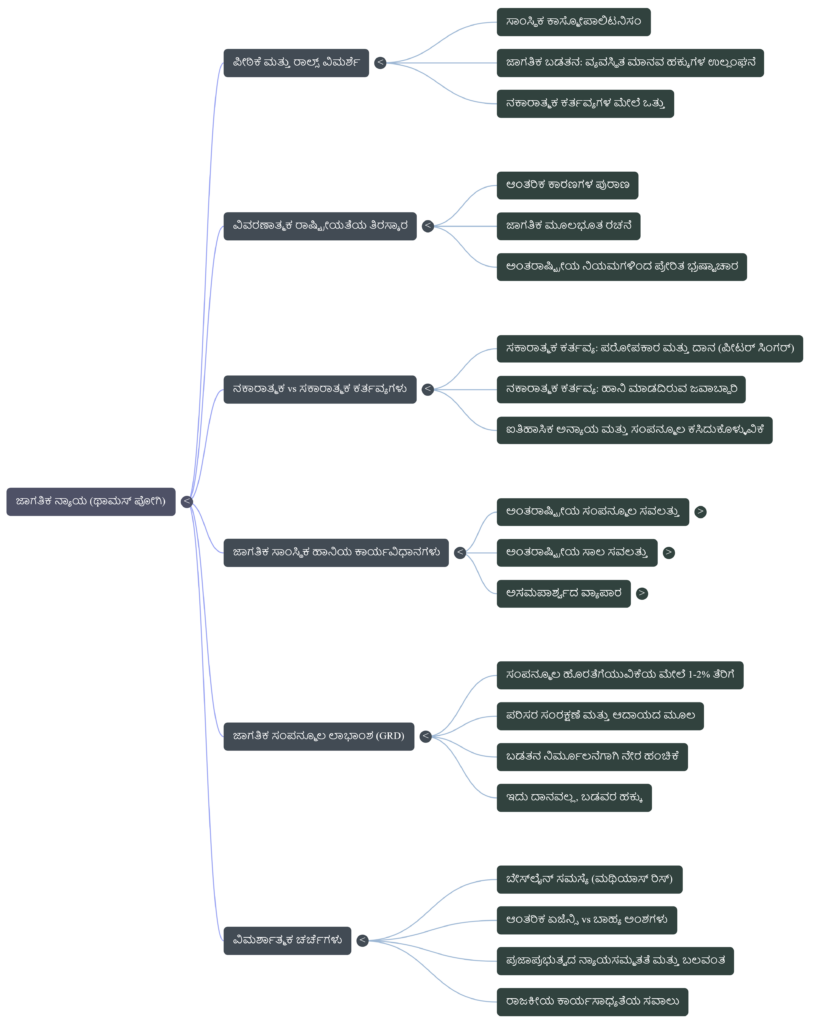
Thomas Pogge—a student of Rawls—became the most influential voice of Institutional Cosmopolitanism, challenging both Rawlsian statism and traditional utilitarian humanitarianism. Pogge argues that the persistence of radical global poverty is not a tragic natural fact or a matter of insufficient charity, but a systemic human rights violation perpetrated by the global institutional order. Because affluent nations and their citizens actively design and impose a global economic architecture that foreseeably and avoidably produces massive poverty, our primary obligation is not a positive duty of beneficence (aid), but a negative duty of justice (to stop causing harm).
“We are familiar with the assumption that the persistence of severe poverty is due to domestic causes… This explanatory nationalism is morally comforting because it makes our failure to help appear as a mere lack of beneficence: we are not saving enough people from dying of starvation and preventable diseases. But this comfort is bought at the expense of ignoring the global institutional context.”
— Thomas Pogge, World Poverty and Human Rights (2002)
2. The Methodological Shift: Rejecting “Explanatory Nationalism”
Pogge’s foundational critique targets Explanatory Nationalism—the dominant assumption in international relations, development economics, and popular discourse that the economic trajectories of states are determined almost entirely by internal, domestic factors (e.g., corrupt governance, poor economic policies, cultural institutions, or geographical endowments).
   [ EXPLANATORY NATIONALISM (Standard View) ]
   Domestic Corruption / Bad Culture / Poor Policy ────► Radical Poverty
   (Affluent states are bystanders; aid is charity/beneficence)

   [ POGGE'S INSTITUTIONAL COSMOPOLITANISM ]
   Global Economic & Institutional Architecture  ────► Corrupt Elites & Resource Wars
   (Affluent states actively impose coercive structures that generate/sustain poverty)
- The Myth of the Pure Domestic Cause: While Pogge does not deny that domestic corruption and authoritarianism harm citizens, he demonstrates that domestic corruption is endogenously incentivized and sustained by global rules designed by affluent nations.
- A Shared Global Basic Structure: Modern globalization has created an interconnected, coercive global basic structure (international trade regimes, financial systems, maritime law, intellectual property regimes). Just as the domestic basic structure is evaluated by its impact on the least advantaged, the global basic structure must be judged by whether it secures basic human rights for all human beings.
3. Negative vs. Positive Duties: The Ethics of “Not Harming”
A cornerstone of Pogge’s theory is his deliberate departure from Peter Singer’s utilitarian approach to global poverty (“Famine, Affluence, and Morality”, 1972). While Singer appeals to positive duties of beneficence (if we can prevent something bad without sacrificing anything of comparable moral importance, we ought to do so), Pogge grounds global justice in negative duties not to harm.
3.1 Why Frame Poverty as a Violation of Negative Duty?
- Libertarian & Conservative Consensus: In Western political philosophy (from Locke and Kant to Nozick), negative duties (do not steal, coerce, or inflict injury) are universally acknowledged as strictly binding, whereas positive duties (charity, rescue) are often treated as discretionary or supererogatory.
- Causal Responsibility: By demonstrating that the affluent world actively causes poverty through institutional imposition, Pogge shows that eradicating poverty is not an act of benevolence, but an act of rectification and compensation for ongoing structural violence.
3.2 Three Grounds of Negative Duty Violation
Pogge identifies three distinct arguments showing how affluent citizens and governments violate negative duties toward the global poor:
- The Historical Argument: Current economic disparities are deeply rooted in a shared historical process characterized by grievous injustices—colonial conquest, slavery, genocide, and resource looting—meaning present holdings cannot be defended as morally clean entitlements.
- The Lockean Proviso Argument: Even under libertarian property rights, appropriation of unowned resources is only just if it leaves “enough and as good” for others. The global poor have been systematically dispossessed of the Earth’s natural resources without fair compensation.
- The Institutional Harm Argument (Pogge’s Primary Focus): We collaboratively impose a global institutional order that foreseeably and avoidably causes severe poverty, while feasible alternative institutional designs exist that would prevent this suffering.
4. How the Global Institutional Architecture Causes Harm
Pogge identifies specific mechanisms within international law and global political economy that actively impoverish the Global North’s trade partners and incentivize domestic authoritarianism in the developing world.
       ┌────────────────────────────────────────────────────────┐
       │     THE COERCIVE GLOBAL INSTITUTIONAL ARCHITECTURE     │
       └───────┬────────────────────────────────────────┬───────┘
               │                                        │
               ▼                                        ▼
  [ INTERNATIONAL RESOURCE PRIVILEGE ]    [ INTERNATIONAL BORROWING PRIVILEGE ]
  Any warlord/dictator who seizes power   Dictators borrow funds in the nation's
  is legally recognized as the rightful   name; international courts enforce
  seller of the nation's commodities.     odious debt on future democracies.
               │                                        │
               └───────────────────┬────────────────────┘
                                   │
                                   ▼
             Incentivizes Coups, Civil Wars, Dictatorships,
             Capital Flight, and Systemic Domestic Poverty
4.1 The International Resource Privilege
- Under prevailing international law, whoever can exercise effective military control over a territory is recognized as the legitimate government entitled to sell that country’s natural resources (oil, diamonds, minerals) on global markets.
- The Structural Harm: This privilege confers immense revenues on tyrants and military juntas, empowering them to buy weapons and suppress democratic movements. It creates a massive financial incentive for coups and civil wars in resource-rich nations (the “Resource Curse”).
4.2 The International Borrowing Privilege
- International law permits authoritarian rulers to borrow money in the name of the state and pledge the country’s assets as collateral.
- The Structural Harm: This provides dictators with funds to entrench their oppression and saddles subsequent democratic governments with odious debt—forcing poor nations to divert billions in taxes from schooling and healthcare to service debt incurred by former oppressors.
4.3 Asymmetric Trade and Protectionism
- While affluent nations demand market liberalization and structural adjustment from developing states, they maintain massive agricultural subsidies, tariffs, and non-tariff protectionist barriers against exports from the Global South (e.g., textiles, agricultural produce).
- Intellectual Property (TRIPS): Monopolistic intellectual property rights enforced by the WTO artificially inflate the cost of essential medicines, foreseeably causing millions of preventable deaths from diseases like HIV/AIDS, malaria, and tuberculosis.
5. Institutional Reform: The Global Resource Dividend (GRD)
Because global poverty is a structural pathology, Pogge argues that solutions must be institutional and reformist, rather than philanthropic. His flagship institutional proposal is the Global Resource Dividend (GRD).
- The Core Mechanism: States would not exercise absolute, unconditioned ownership over the natural resources within their territories. Instead, a small dividend (a 1–2% tax or fee) would be levied on the extraction or use of natural resources (e.g., crude oil, natural gas, minerals, and fertile land).
- Environmental & Economic Double-Dividend: The GRD simultaneously discourages wasteful resource depletion and environmental degradation while generating a predictable, non-charitable revenue stream (estimated at hundreds of billions of dollars annually).
- Distribution: GRD funds would be disbursed directly to governments or grassroots organizations in the Global South strictly conditional on their effectiveness in eradicating extreme poverty and securing basic capabilities (nutrition, clean water, basic schooling, healthcare).
- Not Foreign Aid: Pogge emphasizes that the GRD is not aid; it is an entitlement of the poor and an institutional mechanism to mitigate the ongoing harm caused by the International Resource Privilege and unequal resource distribution.
6. Comparative Matrix: Approaches to Global Poverty & Distributive Justice
| Dimension | Utilitarian Humanitarianism (Peter Singer) | Domestic Statism (John Rawls, Law of Peoples) | Institutional Cosmopolitanism (Thomas Pogge) | Relational Statism / Coercion (Thomas Nagel) |
| Primary Moral Basis | Positive Duty of Beneficence: Prevent bad things if cost is low. | Duty of Assistance: Help “burdened societies” establish institutions. | Negative Duty of Justice: Do not impose an unjust, harmful global order. | Sovereign Membership: Distributive justice requires state coercion. |
| Scope of Distributive Justice | Universal (Global aggregate welfare). | Strictly Domestic (Basic structure of the nation-state). | Universal (The Global Institutional Basic Structure). | Strictly Domestic (Co-citizens within a sovereign legal order). |
| View of Global Inequality | Morally unacceptable if wealth could save lives. | Morally acceptable if societies are internally well-governed. | Unjust because it is sustained by coercive, asymmetric institutions. | Unacceptable only if it violates basic humanitarian rights, not equality. |
| Primary Institutional Remedy | Individual philanthropy; NGO donation; redistribution. | Domestic institutional reform; foreign aid for governance. | Global Resource Dividend (GRD); reform of WTO, borrowing/resource privileges. | Sovereign development; humanitarian relief without global redistribution. |
7. Contemporary Critical Debates & Limitations
In doctoral seminars, Pogge’s theory is critically evaluated along four major analytical axes:
7.1 The Baseline Problem (Mathias Risse)
- The Challenge: To claim that an institutional order causes harm, one must establish a counterfactual baseline of what condition the poor would be in without that order. Philosopher Mathias Risse argues that against historical baselines (e.g., the state of nature or pre-industrial global poverty), the modern global institutional order has actually improved the living standards and life expectancy of billions.
- Pogge’s Rejoinder: The relevant baseline is not the distant past or a Hobbesian state of nature, but an institutionally feasible alternative present order. An economic system harms people if it foreseeably generates massive, preventable suffering compared to a realistic alternative design that could avoid such suffering.
7.2 Overstating Externalism vs. Domestic Agency
- The Challenge: Critics argue that Pogge commits an “externalist fallacy” by blaming international rules for failures that are predominantly domestic. For example, countries like Botswana or South Korea faced the same international economic order as Zimbabwe or Congo but achieved radically different development outcomes due to domestic institutional choices.
- Pogge’s Rejoinder: Pogge does not claim international rules are the sole cause of poverty; rather, they are a necessary structural condition that reliably rewards and empowers predatory domestic elites.
7.3 The Democratic Legitimacy & Coercion Critique (Thomas Nagel, Michael Blake)
- The Challenge: Statists like Nagel (“The Problem of Global Justice”, 2005) argue that egalitarian distributive justice is a specific obligation that only arises among citizens who share a sovereign, coercive state apparatus. Because no global state exists to enforce collective democratic authorship, global socioeconomic demands can only be humanitarian, not claims of justice.
- Pogge’s Rejoinder: Coercion already exists globally. The WTO, the IMF, maritime trade rules, and intellectual property treaties are backed by economic sanctions and geopolitical coercion. Where coercive structural power is exercised, demands for justice and rights-fulfillment inevitably follow.
7.4 Feasibility and the Collective Action Problem
- The Challenge: Realists and institutionalists question whether the Global Resource Dividend is politically feasible without a world government. How could affluent, sovereign states be compelled to tax their own resource extraction and relinquish the International Resource Privilege without centralized global enforcement?
8. Graduate Seminar Discussion Prompts
- Positive vs. Negative Duties:Is Pogge successful in reframing global poverty from a failure of humanitarian beneficence (Singer) to a violation of a negative duty not to harm? What are the normative and legal implications of treating extreme global poverty as a human rights violation perpetrated by affluent democracies?
- The Baseline Problem in Global Justice:How should political theorists construct the baseline for assessing whether an institutional order “harms” the poor? Does Mathias Risse’s historical benchmark undermine Pogge’s claim of structural violence, or is Pogge correct that “feasible alternative institutional designs” represent the only morally defensible baseline?
- Rawls vs. Pogge on Global Distributive Scope:In The Law of Peoples, Rawls explicitly rejects applying the Difference Principle globally, arguing that societies are responsible for their own political culture. Does Pogge’s analysis of the International Resource Privilege and Borrowing Privilege dismantle Rawls’s separation between domestic governance and global basic structures?
- Statism and the Coercion Objection:Critically assess Thomas Nagel’s claim that distributive justice requires a sovereign, coercive state. Does the modern international trade and financial regime generate enough structural coercion to trigger egalitarian demands of justice without a global sovereign?
- Policy Viability of the Global Resource Dividend:Evaluate the institutional mechanics of the GRD. Could an international resource tax be implemented in a non-ideal world of sovereign nation-states, or does it inevitably require a level of supranational sovereignty that would threaten domestic political self-determination?
9. Essential Seminar Bibliography
- Primary Texts by Thomas Pogge:
- Pogge, Thomas. (1989). Realizing Rawls. Cornell University Press.
- Pogge, Thomas. (1994). “An Egalitarian Law of Peoples.” Philosophy & Public Affairs, 23(3), 195–224.
- Pogge, Thomas. (2002 / 2008). World Poverty and Human Rights: Cosmopolitan Responsibilities and Reforms (Original & Revised 2nd Ed.). Polity Press.
- Pogge, Thomas. (2005). “World Poverty and Human Rights.” Ethics & International Affairs, 19(1), 1–7.
- Pogge, Thomas. (2010). Politics as Usual: What Lies Behind the Pro-Poor Rhetoric. Polity Press.
- Key Critical & Comparative Literature:
- Beitz, Charles R. (1979 / 1999). Political Theory and International Relations. Princeton University Press.
- Blake, Michael. (2001). “Distributive Justice, State Coercion, and Autonomy.” Philosophy & Public Affairs, 30(3), 257–296.
- Caney, Simon. (2005). Justice Beyond Borders: A Global Political Theory. Oxford University Press.
- Jagger, Alison M. (Ed.). (2010). Thomas Pogge and His Critics. Polity Press.
- Nagel, Thomas. (2005). “The Problem of Global Justice.” Philosophy & Public Affairs, 33(2), 113–147.
- Rawls, John. (1999). The Law of Peoples. Harvard University Press.
- Risse, Mathias. (2005). “How Does the Global Order Harm the Poor?” Philosophy & Public Affairs, 33(4), 349–376.
- Singer, Peter. (1972). “Famine, Affluence, and Morality.” Philosophy & Public Affairs, 1(3), 229–243.